
History of Las Vegas (in a Nutshell)
RELATED PAGES


2 billion years ago
Present-day Nevada is under water.
10 million years ago
Nevada's mountain ranges take their present-day shapes.
1.5 million-10,000 years ago
Much of Nevada is covered with ice.
12,000 years ago
The earliest evidence of man in Nevada.
4,500 years ago
Native Indians known as Archaic or Desert People inhabit Nevada. They are the ancestors of the Paiute people.
300 BCE
Native Indians called the "basketmakers" inhabit the area. They use a spear-throwing stick, called "atlatl,"  to hunt big-horn sheep.
1150 CE
Pueblo Grande, near today's Overton, 70 miles NE of Las Vegas, becomes the first ghost town in Nevada. It is unknown why this center of the Anasazi civilization is suddenly deserted.
1826
Jedediah Smith, an American explorer, crosses the southern tip of present-day Nevada and makes contact with the Paiutes. He is credited as the first American to enter Nevada. (The first Caucasian credited to first enter Nevada is British fur trader Peter Ogden.)
1829
Mexican trader Antonio Armijo, leading a 60-man party along the Spanish Trail route, camps about 100 miles NE of present-day Las Vegas. Rafael Rivera, a scout, leaves the party and discovers an area with abundant vegetation and several natural springs. He is considered the first non-Indian to set foot in the Las Vegas area. Las Vegas is Spanish for "the meadows" or "fertile plains."
1843-44
Surveyor and cartographer John C. Fremont, sponsored by the US government, and scout Kit Carson, map the Las Vegas area. John C. Fremont camps at Las Vegas and mentions it in a report. "We encamped at a camping ground called Las Vegas. The taste of the water is good, but rather too warm to be agreeable; the temperature being 71 in the one, and 73 in the other [spring]. They, however, afforded a delightful bathing place."
1845
20,000 copies of Fremont's report and a map are printed and become a guide for future travelers through Nevada.
1850
The Las Vegas area, because of its springs, is already a popular rest stop for California-bound emigrants.
1855
The first settlement in Las Vegas is established by 30 Mormons led by William Bringhurst. One of their goals is "to build a fort there to protect immigrants and the United States mail from the Indians and to teach the latter how to raise corn, wheat, potatoes, squash and melons." They build a fort, now a museum and a state historic park, at the intersection of Las Vegas Blvd and Washington St.
1858
The Mormons abandon their fort and return to Salt Lake City.
1864
Nevada becomes the 36th state. Three names were considered for the new state: Humboldt, Esmeralda, and Nevada ("snow-clad" or "snowy" in Spanish). Las Vegas is still part of the state of Arizona.
1865
Octavius Decatur Gass, a former miner and irrigation inspector, builds a ranch on the site of the Mormon fort. He is the first permanent settler in Las Vegas.
1900
The population of Nevada is 42,000. The population of Las Vegas is 19 (nineteen).
1905
The town of Las Vegas is founded on May 15. The railroad auctions 1,200 lots in a single day in the present-day downtown (Fremont St) area.
1907
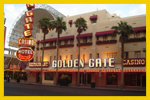
The first telephones are installed. Wooden pipes are used for telephone lines, and one such pipe can be seen on display at the Golden Gate hotel, next to the first telephone installed in Las Vegas. The telephone number was 1.
1909
Las Vegas becomes the county seat of Clark County (named after railroad magnate and Montana Senator William Clark).
1911
The City of Las Vegas is incorporated.
1925
Fremont St becomes the first paved street in Las Vegas.
1928
President Calvin Coolidge signs the Boulder Canyon Project Act, which would build Hoover Dam. Las Vegas, having been in an economic slump for several years, celebrates "just like they was nuts."
1929
Thomas Young starts the Young Electric Sign Co. and the first neon sign appears in the window of the Oasis Club on Fremont St. In 1910, French inventor George Claude attached an electrode to a glass tube containing neon gas, and a new form of illumination was invented. In 1923, an American car dealer from Los Angeles ordered a neon sign from a Parisian sign maker. The sign spelled Packard and was installed on Wiltshire Blvd, causing a sensation.
1931
Hoover Dam construction begins in Black Canyon, 30 miles southeast of Las Vegas. The Nevada Legislature makes gambling legal, approving a bill authored by Phil Tobin, a Nevada rancher, who never visited Las Vegas and had no interest in gambling. The bill is designed to raise taxes to fund public schools. The divorce law changes to require only six weeks' residence for filing.
1935
Hoover Dam is completed and dedicated by President Franklin Roosevelt. Its cost is $175 million. At 720 ft height, it has 3 million cubic yards of concrete and is a considered one of the seven engineering wonders of the world.
Helldorado, a celebration and parade in the Old West tradition, lasting several days, debuts and, after a brief interruption, continues to be held every year in May. The movie Heldorado (one l only, to please the Hollywood censors), starring Roy Rogers, is filmed in 1946.
1941
El Rancho Vegas opens about two miles south of Las Vegas, on Highway 91 or the Los Angeles Highway. It is the first hotel/casino on the future Strip, on 33 acres for which Thomas Hull paid $150 an acre. The Strip got its name from Guy McAfee, a former Los Angeles vice cop who opened Pioneer Club on Fremont St and Club 91 on the Los Angeles Highway. He began referring to this stretch of Highway 91 as the Strip, because it reminded him of the Los Angeles Sunset strip between Hollywood and Beverly Hills.
El Cortez Hotel opens in downtown Las Vegas. The Las Vegas Army Air Corps Gunnery School, now called Nellis Airforce Base, is established and contributes much to the growth of the city. The Basic Magnesium plant is built southwest of Las Vegas, in the present-day City of Henderson.
1942
The Last Frontier hotel opens, the second hotel/casino on the future Strip.
1946
Benjamin "Bugsy" Siegel opens Flamingo on December 26, the third hotel/casino on the Strip. Originally started by Billy Wilkerson, Flamingo was designed as an elegant hotel and casino (a "carpet joint"), in contrast with the "sawdust joints" on Fremont St; additionally, new concepts were introduced to help gamblers gamble more, such as no clocks on walls, no windows, slot machines close to the casino entrance. Downtown, Golden Nugget and Eldorado (later renamed Horseshoe) open.
1948
Thunderbird, the fourth casino on the Strip, opens. It is imploded in 2000, after changing names to Silverbird and El Rancho, to make room for the Turnberry Place. The McCarran Field opens at the south end of the Strip with 12 flights a day.
1951
Atom bomb testing begins at the Nevada Test Site, 60 miles north of Las Vegas. More than 900 nuclear tests are conducted until 1992. Benny Binion refurbishes Eldorado and opens it as Horseshoe, the first downtown casino with carpeting on its floors.
1952
Sahara and Sands open.
1955
The Riviera opens; with nine stories, it is the tallest hotel on the Strip.
1956
Elvis Presley performs at the New Frontier for an audience who did not care for him and his music. He returns in 1969 and performs 826 times at the International (now Hilton) for the next eight years.
1958
Stardust opens.
1960
Clark County population reaches 127,016. Las Vegas' population is 64,405. El Rancho Vegas, the first casino on the Strip, is destroyed by fire and remains a vacant lot to this day (SW corner of Sahara and Las Vegas Blvd).
1964
 The Beatles perform at the Las Vegas Convention Center and stay at Sahara.
1966
Howard Hughes checks into Desert Inn on Thanksgiving Eve, planning to stay for ten days. Caesars Palace opens at a cost of $25 million. The apostrophe is omitted. "We wanted to create the feeling that everybody in the hotel was a Caesar," said Jay Sarno, the creator of Caesars Palace and Circus Circus.
1967
Howard Hughes still lives in the penthouse floor at the Desert Inn, and the hotel management decides to get rid of him so they could rent the rooms to high rollers. Hughes, who "needed a place to sleep," buys the hotel from Moe Dalitz for $13.2 million in cash, paving the way to casino ownership by publicly traded corporations. He begins a casino shopping spree of $300 million which includes Castaways, Frontier, Landmark, Sands, and Silver Slipper in Las Vegas and Harold's Club in Reno. Hughes had sold his 78% interest in his TWA airline, which was paid to him in one check in the amount of $546,549,171.
1969
International (renamed Las Vegas Hilton in 1971) opens. Elvis Presley starts performing at the International. He performs in 837 sold-out shows until 1977.
1973
The original MGM Grand, now Bally's, opens as the largest hotel in the world with 2,100 rooms.
1977
Nevada gaming revenues reach $1 billion. The Nevada Legislature passes a foreign gaming law allowing Nevada-based casino owners to operate casinos outside Nevada's borders.
1989
Mirage opens with 3,039 rooms, at a cost of $630 million. It is the first megaresort.
1993
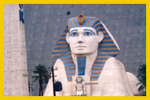
Luxor ($375 million), Treasure Island ($430 million), and MGM Grand ($1 billion) open. MGM Grand, with 5035 rooms, is currently the largest hotel in the world. The Dunes hotel is imploded and the construction of Bellagio begins.
1995
The $63 million Fremont Street Experience opens.
1996
Stratosphere opens. Stratosphere is the tallest free-standing observation tower in the US and the tallest building west of Mississippi. Monte Carlo, modeled after Place du Casino in Monaco and offering "popular elegance," opens.
1998
Bellagio ($1.7 billion) opens.
1999
Paris Las Vegas, the Venetian, and Mandalay Bay open.
2001
Las Vegas declares December 12 Sinatra Day (fifty years after his Las Vegas debut at the Desert Inn).
2003
A 25-year-old engineer from California wins the largest slot-machine jackpot in history ($39,713,982.25), playing Megabucks at Excalibur.
2005
Las Vegas celebrates its centennial. MGM Mirage buys Mandalay Bay Resort for $7.9 billion and now owns 28 casinos and has almost 75,000 rooms on the Strip (Bellagio, MGM Grand, Mandalay Bay, Mirage, Treasure Island--later sold to Phil Ruffin--, Monte Carlo, New York-New York, Excalibur, Luxor, Circus Circus). Wynn Las Vegas opens on April 28, with 2716 rooms, at a cost of $2.7 billion. Harrah's Entertainment buys Caesars Entertainment for $9.4 billion.
2008
Palazzo, a $1.8 billion, 3,025-room resort next to the Venetian, opens in January. Encore, Wynn's additional $2.2-billion, 2,000-rooms (all-suites), opens in December.
2009
CityCenter, an $8.5 billion, 67-acre mixed-use development between Monte Carlo and Bellagio, opens in December. CityCenter comprises: Aria, a 61-story, 4004-room resort and casino; Crystals, a 500,000 sq ft retail and entertainment area; Veer, the leaning towers of Las Vegas, two 37-story residential towers with 335 loft-like condominiums in each tower; Vdara, a 57-story, all-suites, non-gaming, non-smoking condo-hotel; Mandarin Oriental, a 47-story luxury hotel with 392 rooms and suites and 227 residential units on the top floors; Harmon, a 23-story boutique hotel with 400 rooms, to open at a later date.
2010
Cosmopolitan of Las Vegas ($3.9 billion) opens in December, on 8.7 acres between CityCenter and Bellagio.
2011
Sahara closes in May.
